
...
See the example event for layout and styling reference. You must be logged in to WP to view this private event.
Headings (recommended)
- If the description is long or has more than two sections, you should add headings to make it more accessible and easier to scan.
- There are two ways to add a heading:
- Add a new line beneath a paragraph (hit enter key) and where it says "Type / to choose a block" type /heading and select it
- Or click the plus button and type "heading"
- Select the heading size (H3, H4, H5, or H6)
- Make sure to nest your headings in an organized way, like you would for an outline:
- Heading 1 (event title only - this is formatted for you)
- Heading 2 (date and time only - this is formatted for you)
- Heading 3
- Heading 4 (subsection of Heading 3)
- Heading 4 (subsection of Heading 3)
- Heading 3 (e.g. About the Speaker)
- Heading 3
- Heading 2 (date and time only - this is formatted for you)
- Heading 1 (event title only - this is formatted for you)
- Make sure to nest your headings in an organized way, like you would for an outline:
- There are two ways to add a heading:
Separator Line (aka: Horizontal Rule - optional)
- You can add a line between sections by adding a separator block.
- Click the plus button and type "separator". Select the option that appears.
- This can be moved up or down the page with the up and down arrows in the toolbar.
Supporting Images (optional)
These instructions are for adding supporting images within your event description (such as a speaker headshot).
...
- Supporting image dimensions will vary. You should upload the original image (max size 2400px wide) so it will be high quality. See image editing instructions below to learn how to resize an image that is too large or needs to be cropped.
- WordPress creates different sizes of every image you upload and allows you to crop the image or resize it as necessary.
Adding/Selecting an Image
- Click the button with a plus sign and type "image" to search for the image block and select it. (Or hit the enter key to start a new line and type "/image" and select the option that pops up.)
- Select "Media Library"
- If you or a team member already uploaded the image to the WP media library, search for and select the image.
- Tip: When searching the media library, be sure to select "All Files" on the left side before you search so that WordPress looks through the entire media library. Alternatively, if you know which folder the image is in, you can drill down through the path of image folders to get to your image.
- Make sure the image has alt text describing what is in the photo, including all text displayed in the image, to meet accessibility requirements.
- Otherwise, click the Upload Files tab to add your image to the correct media library folder.
- Under Choose Folder, click on "Uncategorized". In the dropdown, look for "Calendar Events" folder and then select your dept/program folder below it.
- Tip: before selecting the Upload Files tab, find the folder you need to add images to in the Media Library tab and select it. When you navigate to the Upload Files tab, your folder will be selected for you.
- Drag and drop the image from your computer or click "Select Files" and find your image on your computer.
- Under Choose Folder, click on "Uncategorized". In the dropdown, look for "Calendar Events" folder and then select your dept/program folder below it.
- Once the image has loaded, you must add alt text describing what is in the image. This is an accessibility requirement for every image that provides readers important context (especially images that have text in them). All text in an image must be typed out in the alt text field. If the image is purely decorative, you can leave the alt text blank.
- You can also add a caption if you like.
- Tip: Adding the caption to the image in the media library means it will display under the image every time it is used. If you might use the image multiple times and don't always want the caption displayed, you will need to add it to the image block in the event editor instead.
- If you or a team member already uploaded the image to the WP media library, search for and select the image.
- Select "Media Library"
- Click the button with a plus sign and type "image" to search for the image block and select it. (Or hit the enter key to start a new line and type "/image" and select the option that pops up.)
Editing an Image
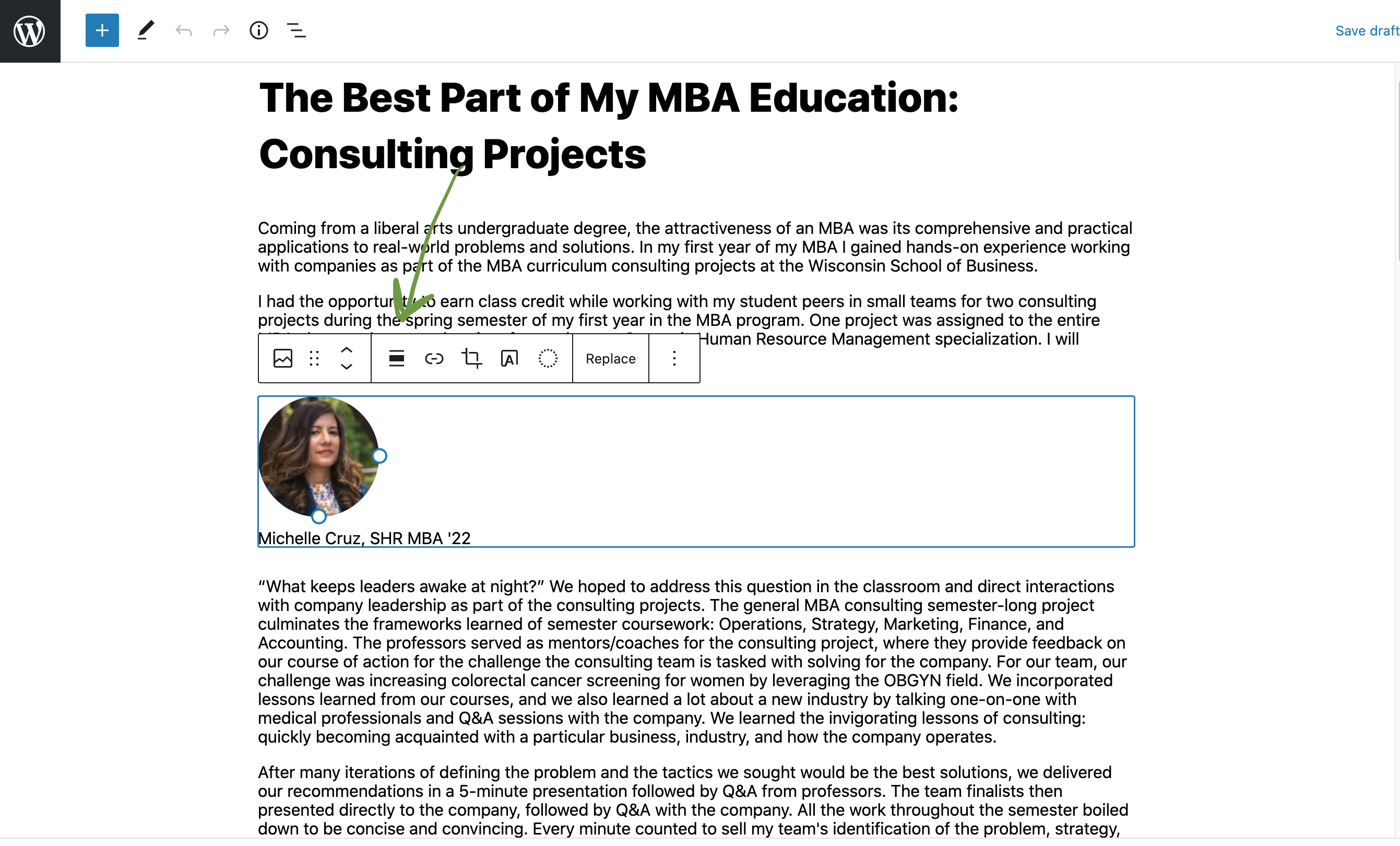
- Click on the image block to see editing options.
- Above the image you can:
- move the image to a higher or lower position on the page (use the up or down arrow; you can also grab the six dots and drag the block up or down)
- choose an alignment option (only use align left, align center, or align right) -- click the three horizontal lines (with the middle one being thicker than the others) in the toolbar to choose your image alignment.
- Above the image you can:
- Click on the image block to see editing options.
...
| Info | ||
|---|---|---|
| ||
Are images (or other content) in your post crowded too close to each other or messing up the formatting of other content? This can happen when change an image's alignment (e.g. when you choose "align left" or "align right") Try adding a Spacer block between/below them.
|
Deleting an Image
- Use one of the following methods:
- From a blog post, click on an image block and click "replace" if you already have an image added to the block. From there, find the image to delete and click "Delete permanently" (this will be under the image on the right side of the screen).
- Go to the WP login dashboard and click Media in the left side menu. Find your image by searching or going through the folders and hover over it. Click "Delete permanently".
- Use one of the following methods:
Accordions (optional)
Accordions should only be used for event FAQs (frequently asked questions)
...