
| Info | ||
|---|---|---|
| ||
As of December 2025, basic Eloqua training will be done through UW-Madison's Eloqua Canvas course. All new users will automatically gain access to the course. If you are an existing user and would like access to the Canvas course training, please fill out the Redwood Canvas Access Form. The training document below will outline WSB-specific Eloqua training. It is currently in progress, so apologies for any confusion. |
Quick Links
- General Eloqua documentation 🡥 (UW-Madison wide)
- How to Request access
- How to Login
- Using WSB Email Templates
- Common pitfalls/mistakes to watch out for
- Accessibility quick tips
- »
- Presend Checklist for WSB (UW Presend Checklist 🡥)
- Sending your first email
- File Organization within Eloqua
- WSB Brand Guidelines for emails
- How to create a non-Eloqua sent email in Eloqua
- Creating engaging email content 🡥 (UW-Madison IT)
Table of Contents ▼
| Table of Contents |
|---|
UW-Madison vs School of Business Documentation
Most Eloqua documentation is available on the UW-Madison wide Eloqua Marketing Automation Knowledge Base. Use this to reference basics like navigating Eloqua, uploading contacts, and setting up email campaigns. The Marketing Automation team, which serves all of UW-Madison, can be reached at marketingautomation@wisc.edu, and usually responds to emails within a couple business days. They can answer most questions on how to use Eloqua, but may not be able to answer questions on WSB Templates or other design recommendations.
The documentation below, as well as the subpages of this page on the wiki, are for WSB specific needs, such as using our custom templates, as well as some of our team's guidelines. The WSB Web Team can be reached at webteam@wsb.wisc.edu. We aim to complete Eloqua related requests within one week of receiving your email.
Eloqua Canvas Course
Basic Eloqua training is done through the UW-Madison's Eloqua Canvas course (created by the Marketing Automation team). All new users will automatically gain access to the course. How to Request access to Eloqua.
...
Do not delete or edit the headers and footers of your email! These are all branded elements.
Review the Email Template Breakdown to learn about each part of the WSB custom template.
| Anchor | ||||
|---|---|---|---|---|
|
...
Email Editing Pitfalls
- When sending a test email, do not use the default "Email Checker" option. It checks emails by clicking on all the links, which includes the unsubscribe button. Always select "HTML email" instead.
- The Fill out your sender properties according to the guidelines. The sender email must always end in "@explore.wisc.edu". Any others will cause the email to bounce from all wisc.edu email addresses, and your email all those addresses will be marked as invalid. Fill out your sender properties according to the guidelines.(If you accidentally do this, please follow these instructions)
- Even if it's just a test email send, this will still affect anyone you sent the test email to.
- Make sure to select a folder whenever you upload/create anything (photos, emails, etc). If you add something to the root folder, please move it to the appropriate department folder afterwards.
- When creating an email, choose one of the templates for your specific department.
- When uploading contacts, be careful when entering info, since it will override the contact's info for all other groups (across UW-Madison)
- Prior to activating an email, go over the Presend Checklist
- Don't forget to fill out preview text! It's optional, but if you don't fill it out, the first thing a user will see under the subject line will be "Trouble viewing this email?"
- When uploading a photo from within an email, make sure to select a folder for it to go into. Otherwise, it will end up in the root folder "all"!
- Rather than uploading from your email, it's better to upload your photos from within the image library itself (you can open another tab in Eloqua if you want to keep your email open) by going to Assets>Components>Images and navigating to the folder you want to upload to, then click "Upload" in the top right corner. From there, you can upload multiple images at a time.
- Eloqua will prevent you from sending the same email to the same person twice, even if you completely change the email. Make sure you're creating a new email, not just editing an old one. When adding an email address, you need to make it a link. To add an email address link, highlight the text, click on the hyperlink icon, and on the left sidebar add "mailto:emailaddress@wisc.edu".
- Don't just edit an old email. Eloqua will prevent you from sending the same email to the same person twice, even if you completely change the contents of the email.
- You can go to an old email and click File > Save As to make a copy, but keep in mind that it's better to create a new email from a template instead, to get the most up to date version of the template. If you're current templates aren't good enough, request a custom one from the web team.
- Prior to activating an email, go over the Presend Checklist
- Preview text is "optional", but it's important!
| Anchor | ||||
|---|---|---|---|---|
|
Your emails are required to be accessible.
Not just for legal/compliance reasons, but because accessible emails benefit everyone by making emails easier to read and interact with. The more accessible your email is, the more likely your audience will actually read it!
Ensuring accessible emails is important both for improving usability and being inclusive of all email users. The following tips are just the basics, and it's recommended you take your own time to research accessibility strategies. Review campus's email accessibility guide for details beyond these tips.
- Write it short and to the point. The longer the text in your email is, the less likely anyone is to read it, and the harder it is to understand. Write using Plain Language practices whenever possible.
- Add alternate text to all images. Alt text is a requirement when you use images in your email.
- Keep your images between 300-1200px wide. Excessively large images
- Add alternate text to all photos, especially photos with text.
- After you've inserted a photo into the email, select it, and type into the alt text field in the left sidebar.
- Alt text should include any text that's within the photo, or a basic description of what's in the photo. If it's a headshot of a person, simple type in their name.
- Don't use images that are larger than necessary. Images can slow down your email and consume a lot of data, which is especially problematic for people with limited internet access. It also increases the odds of your email being blocked by a spam filter..
- View our full image sizing guide »
- Full-width images should be 600 pixels wide. (If image quality is a priority, 1200px is okay)
- Half-width (and smaller) images should be 300 pixels wide.
- For bonus points, run your image through tinypng.com before uploading it to further shrink the file size.
- Photo editing quick guide
- Only use all caps for acronyms. Screen readers read anything in all caps letter by letter, not as a word. If you wish to emphasize text, use bold. (don't use underlines, those should be reserved for links only).
- Do not use underlines unless it's for a link! Users expect underlines to be links, and it will be confusing if they are not.
- Do Use descriptive link text, and do not use phrases like "click here", "use this link" for links/buttons. Link text should make it clear where the user is going, with as much context as possible. "Sign up for our newsletter" "Read more about ____" "Apply now" are all decent examples of button/call to action text. When an action doesn't make sense, link text like "student resources", "list of business organizations", "our career team" might be appropriate. (This is done because screen reader users sometimes navigate by link to "skim" content. If the text linked doesn't provide enough context, a user will have to spend time figuring it out.)Likewise, don't . Do not include the entire URL.
- View our link and button guide » as text in your email. Don't use: "https://www.reallylongurl.com/morewordscontinously" (this is because screen readers will spell out every letter in the link. You can imagine how tedious that is.)
- Pay attention to header hierarchy. In the case of our email templates, the H1 Header 1 is used exclusively for the department name, and after that the main headers of the email are H2sHeader 2s. H3s Header 3s should be used as subheaders of H2sHeader 2s.
- Design note: Please don't bold headers. They are already styled to be large.
- Use sentence case for links, buttons, and headings
...
- .
Contact Uploads
When uploading contacts, your “Contact Label” should always be “WSB”. Please review the contact upload documentation for step by step instructions.
...
If you want to have a personalized greeting in your email, such as "Dear First Name", you can use a Field Merge to pull in that name from your Contact list.
| Expand | ||
|---|---|---|
| ||
Just include a column in your contact list spreadsheet with the info for each contact- add a column for "First Name" and a column for "Last Name" (if you're including that) before you upload your contact list.
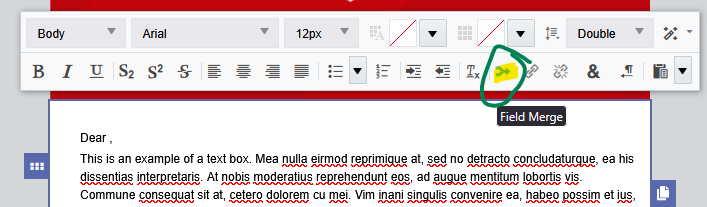
Then, in a text box in your email, click the Field Merge icon.
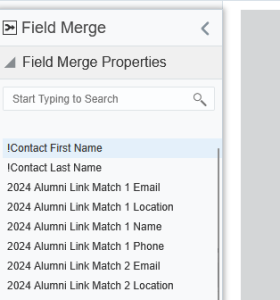
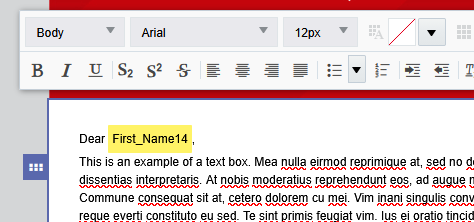
Double click "!Contact First Name" from the left sidebar. It will insert a bright, highlighted chunk of text. You can test to see if it works by previewing your email as different members of your contact list.
Keep in mind that updates to the person's contact happen across all of UW-Madison, so another school or department might override what you uploaded. This is usually fine, but they may not know your contact's preferred name, or they may upload the name in all caps, with a typo, etc. If you would need to upload your own data that is private and specific to WSB for customization or segmentation, you may want to use a custom data object or CDO. To find out more about CDOs, please contact us for assistance. Here's the CDO example template: custom-data-object-example |

| Anchor | ||||
|---|---|---|---|---|
|
...